How to use AI demand forecasting to cut food waste in restaurants and food factories: the data you need, how to start small, and where forecasts fall short.
1. What Is AI Demand Forecasting to Cut Food Waste?
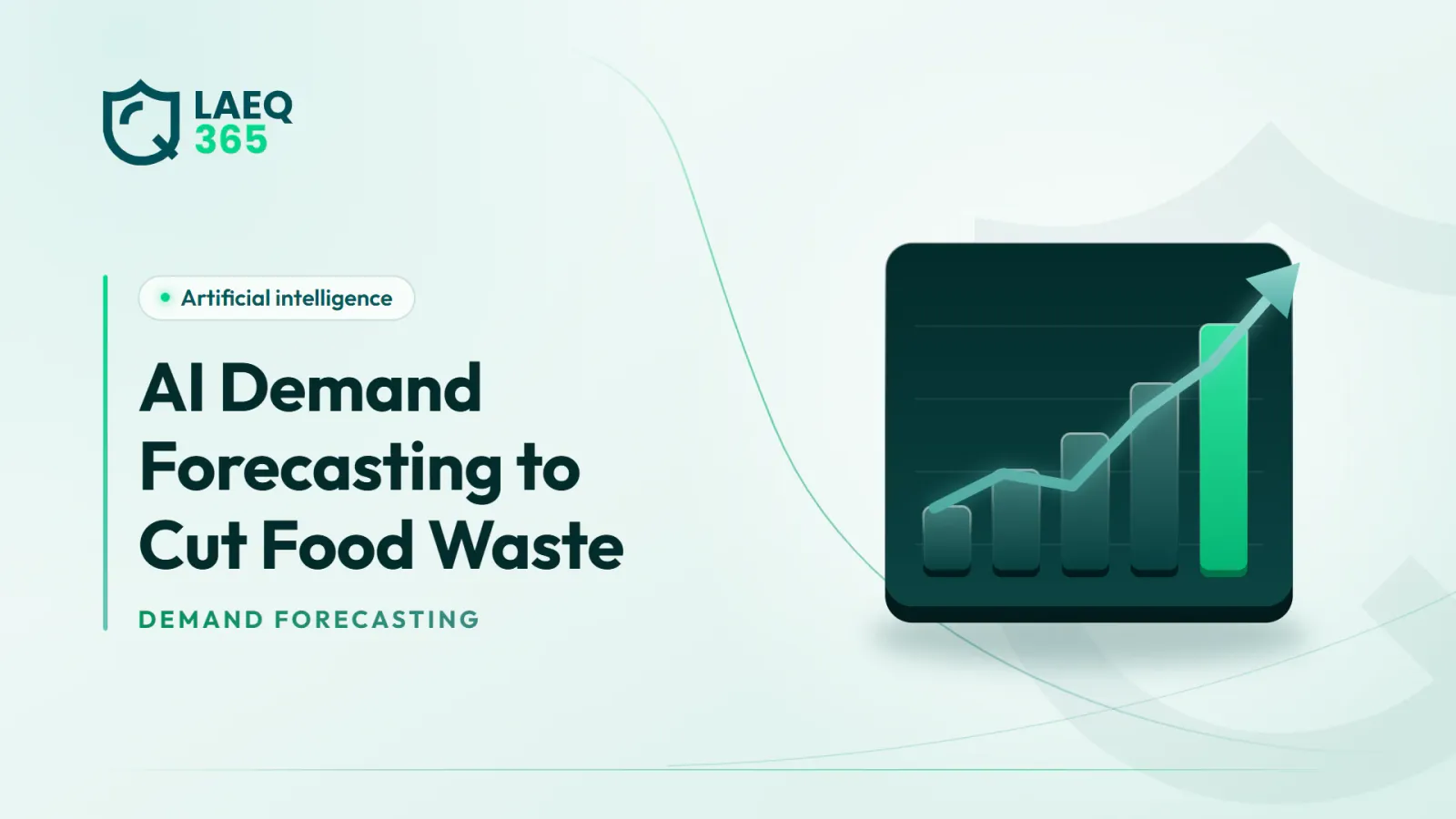
AI demand forecasting to cut food waste means using models that learn from your past sales, and the factors that drive them, to estimate what you will sell tomorrow or next week, then turning that estimate into prep quantities and purchase orders that are closer to reality. The idea is simple: the closer your prep is to what customers actually order, the less ends up in the bin at closing time.
In many restaurants, prep quantities are set by the head chef or branch manager based on experience. That experience is valuable, but it is shaped by memory and impressions. A manager may remember that Thursdays are busy, yet not recall precisely that demand for a particular dish drops in the last week of the month, or that cold drinks spike during heatwaves.
A forecasting model does not replace that experience. It puts a data-based suggested number in front of it, and leaves the final decision with a person. Forecasts can work on several levels:
- Dish level: how many portions of each menu item you expect to sell in each period.
- Ingredient level: the meat, vegetables and dairy you need to cover those dishes.
- Branch level: the differences between a branch in a residential area and one in an office district.
Forecasting is one piece of a bigger picture that we cover in our guide to AI for restaurants.
2. Why Does Food Waste Happen in Restaurants and Factories?
Before discussing technology, it helps to understand where waste actually comes from, because forecasting only addresses part of it. Waste usually has four main sources:
- Over-production: preparing more than you sell, so prepared food reaches the end of its safe holding time before it is used.
- Over-purchasing: ordering more raw material than you need, so it sits in the store until it approaches its expiry date.
- Storage mistakes: not applying first in, first out, or keeping products at the wrong temperature.
- Plate waste: what customers leave behind because of portion sizes or dish quality.
Demand forecasting targets the first two directly, because both come down to one question: how much will we need? Storage mistakes call for operational discipline, such as applying FIFO food storage and monitoring temperatures. Plate waste calls for a review of portions and recipes.
It is also important to separate waste from safety. Food that has passed its safe holding time must be discarded whatever it cost, and pressure to reduce waste should never push anyone on the team to use ingredients whose safety is in doubt. The goal is to avoid making the surplus in the first place, not to stretch the life of food that is no longer safe.
Keeping that distinction clear from the start protects both your customers and the credibility of the whole waste-reduction effort.
3. What Data Does a Demand Forecasting Model Need?
Forecast quality depends directly on data quality. You do not need complex systems at the start, but you do need data that is regular and honest. The most important inputs are:
- Detailed sales history: from your point-of-sale system, by item, date, hour and branch, ideally covering at least several months.
- A waste log: what is thrown away each day and why, whether it was expired holding time, spoilage or a prep error.
- The local calendar: seasons and occasions such as Ramadan, Eid, school holidays and payday weekends, which clearly change demand patterns in Saudi Arabia.
- Promotions and campaigns: any discount or advert that temporarily lifts demand for a specific item.
- Order channels: the difference between dine-in orders and delivery apps.
- External factors: such as weather or events near the branch, where that data is available.
The most neglected of these is the waste log. Many businesses know exactly what they sold but have no idea what they threw away. Without that log you cannot measure the impact of forecasting, or tell whether the problem lies in prep, purchasing or storage.
A practical tip: start by recording waste on a simple form at the end of every shift, noting the item, the quantity and the reason. That log alone may reveal clear opportunities before you use any smart model at all. It also gives you the baseline you will need later to prove whether forecasting made a difference.
4. How Do Accurate Forecasts Actually Reduce Waste?
A forecast on its own is just a number on a screen. Its real effect shows up when it is tied to specific daily decisions. These are the main points where forecasting turns into less waste:
- Daily prep lists: instead of preparing the same quantity every day, the morning shift receives a suggested quantity for each item based on the expected day.
- Batch cooking: when the kitchen knows demand peaks at lunchtime, it can cook smaller, more frequent batches rather than one large one.
- Purchase orders: linking forecast quantities to ingredients helps you order just enough, especially for perishables such as leafy greens and dairy.
- Stock allocation across branches: for groups with a central kitchen, forecasts help distribute quantities according to each branch's needs.
- Shift planning: knowing when the rush comes helps you deploy staff, which reduces prep mistakes made under pressure.
An illustrative example: a restaurant cooks a fixed quantity of rice every day and notices that part of it is discarded on quiet days. When the model suggests smaller quantities for Sundays and Mondays and larger ones for the weekend, the surplus shrinks without the dish running out on busy days. This matters for food safety too, because cooked rice is one of the foods that needs careful cooling and holding.
Whatever is left over despite all the planning still needs to be handled properly, which is where sound restaurant waste management comes in.
5. How Can You Start Small Without a Big Investment?
You do not need a large project to try demand forecasting. A small, well-planned start beats an ambitious project that stalls after a few months. Here is a suggested phased plan:
- Step one, pick a narrow scope: one branch and a handful of items that are either the most wasted or the most expensive.
- Step two, clean the data: make sure item names are consistent in the point-of-sale system and that the waste log is filled in every day.
- Step three, start with the simplest method: the average sales for the same weekday over the past few weeks can be a good baseline before any complex model.
- Step four, add intelligence gradually: many point-of-sale and inventory systems now offer built-in forecasting features you can switch on.
- Step five, compare and measure: compare suggested quantities with actual sales and waste over several weeks.
- Step six, expand carefully: move to more items and branches once the benefit is proven.
More important than the tool is involving the chef and branch manager from day one. If they feel the suggested number is imposed on them without explanation, they will ignore it. If they help review and adjust it, it becomes a tool they rely on.
It also helps to agree in advance how long the pilot will run and what result would justify expanding it, so the decision is based on evidence rather than enthusiasm. If you are interested in the stock and expiry side specifically, read our article on AI inventory and expiry management.
6. What Are the Limits and Risks of Forecasting?
A forecast is an estimate, not a certainty, and anyone who treats it as fixed truth will make costly mistakes. These are the main limits you should be aware of:
- Unprecedented events: a nearby road closure, a surprise event or a major menu change are things the model cannot know about if they never appeared in past data.
- New branches: a newly opened branch has little history, so its forecasts are less accurate in the first months.
- Low-volume items: it is hard to forecast a dish that sells only a few times a day, and simple rules usually work better for those.
- Polluted data: days when the point-of-sale system was down, or an item was sold out, show artificially low sales and can mislead the model unless they are flagged.
- The risk of stock-outs: focusing too hard on cutting waste can leave you running out of key items, which hurts the customer experience.
That is why human oversight must stay in place. Treat the suggested number as a starting point, and give the branch manager the authority to adjust it while recording the reason. Those adjustments are themselves useful data that improve the model over time.
On the data side, remember that sales records may be linked to customer data from delivery apps or loyalty programmes. If so, handle them in line with the Personal Data Protection Law (PDPL), overseen by the Saudi Data and AI Authority (SDAIA), and use aggregated data wherever you can.
7. How Do You Measure the Success of Demand Forecasting?
Without clear measurement, you will never know whether forecasting is worth the effort. Define your indicators before you start, and compare them with a similar earlier period wherever possible. The key indicators are:
- Waste per item: by weight or number of portions, every week.
- Waste as a share of sales: because rising sales can hide rising waste.
- Stock-outs: how often an item ran out before the end of the period, to make sure you are not cutting waste at the customer's expense.
- Forecast accuracy: the gap between the suggested quantity and actual sales.
- Adoption rate: how often the team used the suggested quantity, and how often they changed it and why.
Review these indicators in a short weekly meeting with the chef and the branch manager. If waste has not fallen even though forecasts are accurate, the problem usually lies in execution or storage, not in the model.
This is where forecasting connects with your other quality tools. Waste caused by products spoiling in fridges, for example, is not solved by forecasting but by temperature monitoring and regular inspection of storage areas. On a platform such as LAEQ365, you can track fridge temperatures with sensors and spot recurring storage observations in inspection reports through AI analysis, closing a major source of waste that demand forecasting does not cover.
Conclusion
AI demand forecasting to cut food waste does not need a large project to start making a difference. Organized sales records, an honest waste log, a pilot in one branch with a few items and a weekly review with the chef are enough to show whether forecasts are reducing surplus without leaving customers without their favourite dishes. Remember that the suggested number is a starting point and the decision stays with your team.
Because part of your waste comes from poor storage and refrigeration failures, fridge monitoring and regular inspections complete the picture. See what LAEQ365 offers on the plans and pricing page, and explore more in our AI articles.
Read also: AI Sensor Data Analytics: From Readings to Decisions · AI in Food Safety: A Practical Guide for Restaurants & Factories
Frequently asked questions
- Is AI demand forecasting suitable for small restaurants?
Yes, in a simplified form. A small restaurant can start with consistent sales records, a daily waste log and a simple comparison between similar days. Many current point-of-sale systems include built-in forecasting features that do not need a technical team. What matters is that the data is regular and that the owner reviews the results every week.
- How many months of data do I need before forecasts become useful?
There is no fixed number, but forecasts improve as your data covers a longer period and more seasons. Several months of consistent sales are usually enough to capture weekly patterns, while the effect of seasons such as Ramadan needs data from at least one previous year. Early on, combine the suggested number with your team's seasonal experience.
- Can forecasting cause items to run out?
Yes, if it is tuned too conservatively or left unreviewed. That is why you should track stock-outs alongside waste and add a safety margin for core menu items. Giving the branch manager the authority to adjust the suggested quantity, with a recorded reason, protects against this risk and helps the model improve.
- Does demand forecasting solve food waste completely?
No. It addresses over-production and over-purchasing only. Waste caused by storage mistakes, fridge failures or portion sizes needs other measures, such as FIFO, temperature monitoring and recipe reviews. The best results come from combining forecasting with operational discipline.
- Can I use ingredients close to their expiry date to reduce waste?
Yes, as long as they are still within their expiry date, have been stored correctly and pass a quality check, and ideally they should be used first. Anything past its expiry date, or past its safe holding time after preparation, must be discarded. Reducing waste never justifies a food safety risk.