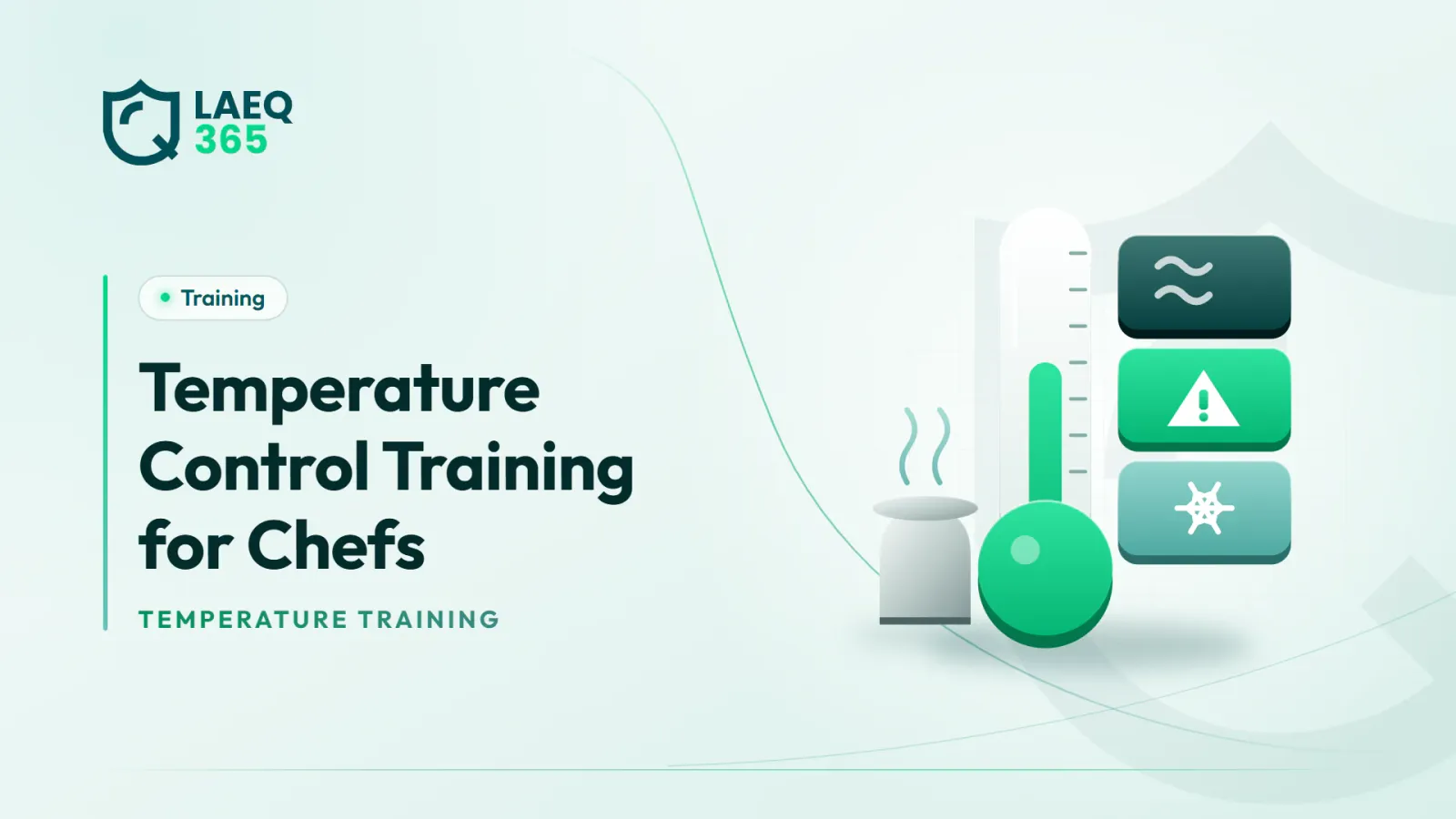
Temperature control training for chefs: using and calibrating probe thermometers, key temperatures, honest record-keeping and practical drills that stick.
1. Why Does Your Kitchen Need Temperature Control Training for Chefs?
Temperature control training for chefs is a practical programme that teaches the kitchen team to measure food temperature correctly with a probe thermometer, to know the limits your business uses for cooking, hot holding, cooling and storage, to record readings honestly, and to take the right action when a reading falls outside those limits. An experienced chef may know chicken is "done" from its colour and texture, but colour doesn't prove that the bacteria at the centre have been killed.
Many inspection findings don't come from a missing thermometer; they come from using it badly: probing the surface instead of the centre, a thermometer that hasn't been checked for accuracy, or a log filled in at the end of the day with suspiciously similar numbers that were never actually measured. Inspectors know these patterns well.
The aim of the training isn't for chefs to memorise a table of figures. It is to build three habits:
- Measure instead of guessing: at every critical point your food safety system defines.
- Measure correctly: in the right part of the food, with an accurate, clean thermometer.
- Act on deviations: don't just write down a bad number; correct the problem and report it.
The science behind the danger zone and why temperature matters is covered in our guide to the food temperature danger zone. This article focuses on turning that knowledge into an everyday skill for your chefs.
2. How Do You Train Chefs to Use a Probe Thermometer Correctly?
A probe thermometer is a simple tool, but there are many ways to misuse it. Start with a live demonstration on real food from your kitchen, then have each chef repeat the measurement in front of you.
Points to train on:
- Insert the probe into the thickest part: the centre of the piece, away from bone, fat and the bottom of the pan.
- Wait for the reading to settle: some thermometers take several seconds, and the first number can be misleading.
- Probe more than one piece: in a large batch, check the biggest pieces and those furthest from the heat.
- For liquids and sauces: stir first, then measure in the middle.
- Clean and sanitise the probe between readings: especially when moving from raw to cooked food, using the probe wipes approved in your business.
- Never go from raw to cooked without sanitising: the thermometer itself can spread contamination.
A useful exercise: prepare three pieces of chicken cooked for different lengths of time and ask each chef to probe them and decide which needs more cooking. Then compare their decisions with the actual readings. Many are surprised by the gap between what "looks cooked" and what is actually cooked.
If your business uses smart digital thermometers that send readings straight to a system, they reduce transcription and logging errors, but the skill of probing correctly is still needed either way.
3. How Do Chefs Check Thermometer Accuracy and Calibration?
An inaccurate thermometer is more dangerous than no thermometer, because it creates false confidence. Checking accuracy should be part of every chef's training, not a task left to the supervisor alone.
Two common quick checks in the kitchen:
- The ice-water test: fill a cup with crushed ice and a little water, leave it a few minutes, then insert the probe without touching the bottom. The reading should be close to 0°C.
- The boiling-water test: insert the probe into boiling water. The reading should be close to 100°C, bearing in mind that water boils at a slightly lower temperature in cities at higher altitude.
Your procedures should define the acceptable margin of error and how often to check, for example weekly or whenever a thermometer is dropped, and what happens if a thermometer fails: take it out of use, recalibrate it according to the manufacturer's instructions, or replace it. Record the result of every check.
Chefs also need to look after thermometers day to day: change the battery when it gets weak, store the thermometer somewhere clean, and don't submerge it in water unless it is designed for that.
4. Which Key Temperatures Should Every Chef Know?
Don't overload chefs with a long table of numbers. Give each station only the figures that apply to it, printed on a clear card next to the station. The reference here is your own food safety system and the official requirements that apply to you, because limits can differ slightly between sources.
The temperature points that typically appear in any kitchen:
- The danger zone: the range in which bacteria multiply quickly, cited in many references as roughly 5°C to 60°C.
- Core cooking temperature: this varies by food type; poultry and minced meat usually need a higher core temperature than whole cuts. See our guide to safe cooking temperatures for details.
- Hot holding: keeping food above the upper limit of the danger zone throughout service.
- Cooling: bringing cooked food down quickly, in defined time stages, as explained in our guide to cooling cooked food safely.
- Chilled and frozen storage: the fridge and freezer temperatures your business has set.
- Reheating: reaching the specified temperature quickly, not just "warming through".
Train chefs to ask themselves one question: "What number do I need to reach here, and what do I do if I don't reach it?" If they can answer it at every station they work on, they have understood the topic.
5. How Do You Train Chefs to Record Temperatures Honestly and Accurately?
The log is the only evidence that measuring actually happened. It loses all its value if it turns into numbers written from memory. Inspectors quickly spot a log whose figures match day after day, or one filled in with the same pen at the end of the shift.
Teach chefs the recording rules:
- Record immediately after measuring: not at the end of the shift.
- Write the actual number: even if it is out of range, because that is exactly what the supervisor needs to know.
- Record the corrective action: for example "cooked further until the target was reached" or "food discarded".
- Time and name: every reading should carry the time and the name of the person who took it.
- No erasing: if they make a mistake, they cross it out with a single line and write the correct figure.
Explain to chefs that an out-of-range number recorded with a corrective action shows a system that is working well, while a perfect log with no deviations at all invites suspicion. That message changes how people approach the log.
If your business uses a digital system, LAEQ365 lets staff record readings from a phone with the time and user captured automatically, alongside temperature sensors in fridges and cold rooms, so the record becomes more trustworthy and easier to review. You can also link these readings to the control points in your HACCP plan, as described in our guide to CCP monitoring records.
6. Which Practical Drills Build Temperature Control Skills?
Knowledge fades; a skill that is practised regularly stays. These short drills each take 10 to 15 minutes:
- "Where's the centre?" drill: pieces of meat and chicken in different sizes and shapes, and each chef shows where they would insert the probe.
- Calibration drill: each chef runs the ice-water test on their thermometer and records the result.
- Deviation drill: the supervisor gives an out-of-range reading, such as hot-held food below the limit, and asks: what do you do now? When do you discard instead of reheating?
- Cooling drill: follow a container of rice or sauce from cooking to the fridge, measuring at each time stage.
- Log drill: a temperature log with deliberate errors, and the chef has to find them.
- Receiving drill: probe a chilled or frozen delivery on arrival and decide whether to accept or reject it.
Run these drills during the pre-shift briefing or in quiet periods, one drill a week, rotating the target station each time. Over a couple of months, every chef will have practised every critical point at least once.
7. What Are the Common Mistakes in Temperature Training for Chefs?
These are mistakes we see often in kitchens, and they leave training with no real effect:
- Experience instead of measurement: "I've been cooking for twenty years" doesn't replace a thermometer.
- One thermometer for the whole kitchen: so chefs have to hunt for it, or skip measuring altogether.
- Not sanitising the probe: turning the thermometer into a vehicle for contamination.
- Teaching numbers without corrective actions: the chef knows the target but not what to do when it isn't reached.
- Filling in logs later: numbers from memory make the log worthless.
- Neglecting calibration: thermometers no one has checked for months.
- Forgetting new and temporary cooks: in peak seasons, people enter the kitchen without any of this training.
Most of these are fixed by providing enough thermometers for every station, a clear temperature card, a short weekly drill and daily, not monthly, log reviews by the supervisor.
Conclusion
Temperature control training for chefs turns numbers on a wall chart into a daily habit: probing in the right place with a clean, accurate thermometer, knowing the target at every station, recording honestly and immediately, and taking clear corrective action when something is off. Short weekly drills are what stop the skill from fading.
Start by giving every station a thermometer and a clear temperature card, then pick one drill to run this week. If you would like to digitise your temperature records and connect them to sensors, take a look at LAEQ365 plans.
Read also: Kitchen Fire Safety Training: From Oil Fires to Evacuation · New Restaurant Employee Onboarding: A 30-Day Training Program
Frequently asked questions
- Where should a chef insert the thermometer in a piece of meat?
In the thickest part of the piece, at its centre, away from bone, fat and the bottom of the pan, because the centre is the last part to heat up. In large batches, measure the biggest pieces and those furthest from the heat source.
- How often should a food thermometer be checked for accuracy?
That depends on your procedures and the manufacturer's instructions; many kitchens check weekly and after any drop or knock. The ice-water test is commonly used, and a thermometer should be taken out of use if its reading falls outside the acceptable margin.
- Is the colour of food enough to tell it is cooked?
No, colour and texture don't guarantee that the centre has reached a safe temperature; meat can look cooked outside while still undercooked inside. Measuring with a probe thermometer is the reliable method, especially for poultry and minced meat.
- What should a chef do if a reading is below the required limit?
Take the corrective action defined in your food safety system, such as cooking or reheating further until the target is reached, or discarding the food if it has exceeded the permitted time in the danger zone. Then record the reading and the action and inform the supervisor.
- Do chefs need to record every temperature reading?
They need to record readings at the points your food safety system specifies, such as cooking, cooling, hot holding and receiving. Records should be made immediately, with the actual figure, the time and the name, plus the corrective action whenever there is a deviation.