What is cross-contamination in the kitchen and how do you prevent it? Learn its types, cutting board colors, fridge order and a daily checklist.
1. What Is Cross-Contamination in the Kitchen?
Cross-contamination is the transfer of microbes or harmful substances from a food, surface, tool or person to another food. The classic example: cutting raw chicken on a board, then cutting salad vegetables on the same board without washing and sanitizing it, so the bacteria transfer to food that will not be cooked afterwards.
The danger of cross-contamination is that it cancels out the effect of proper cooking. You may cook chicken until its center reaches 74°C, but if you touch it with the same tongs you used to turn the raw chicken, or put it back in the tray it sat in while raw, you have contaminated it again.
Cross-contamination usually happens through four routes:
- Food to food: juices from raw meat dripping onto ready-to-eat foods in the refrigerator.
- Surface or tool to food: boards, knives, tongs, work surfaces and scales.
- Hands to food: touching raw food and then ready-to-eat food without washing hands or changing gloves.
- Shared equipment: the probe thermometer, can openers, blenders and slicers.
In high-volume restaurants, cross-contamination is one of the most common risks, because speed at peak time pushes staff to cut corners. Preventing it must therefore be built into the kitchen's layout, tools and procedures, rather than relying only on workers remembering.
2. What Are the Four Types of Cross-Contamination?
When we talk about cross-contamination, people immediately think of bacteria, but the concept is broader than that and includes four types that an establishment's procedures must cover:
- Biological contamination: the transfer of bacteria, viruses and parasites. This is the most dangerous type and the one most linked to food poisoning, such as Salmonella transferring from raw chicken to a salad.
- Chemical contamination: cleaning agents, pesticides or industrial oils reaching food, for example when spraying a cleaner near uncovered food, storing detergents above food, or using empty food containers to store chemicals.
- Physical contamination: foreign objects falling into food, such as broken glass, pieces of plastic from lids, staples, hair, jewelry and fragments from worn metal tools.
- Allergen cross-contact: an allergenic protein, such as peanuts, sesame or milk, reaching a dish that is supposed to be free of it. This type is not removed by cooking, and a very small amount may be enough to trigger a serious reaction in some people. We cover this in detail in our guide to managing food allergens in restaurants.
Dividing the risks this way is useful when writing procedures, because each type has different controls. Bacteria are prevented through separation and sanitizing, chemicals through separate storage and labels, foreign objects through glass and clothing policies, and allergens through dedicated tools and surfaces.
3. How Do You Prevent Cross-Contamination With Color-Coded Cutting Boards?
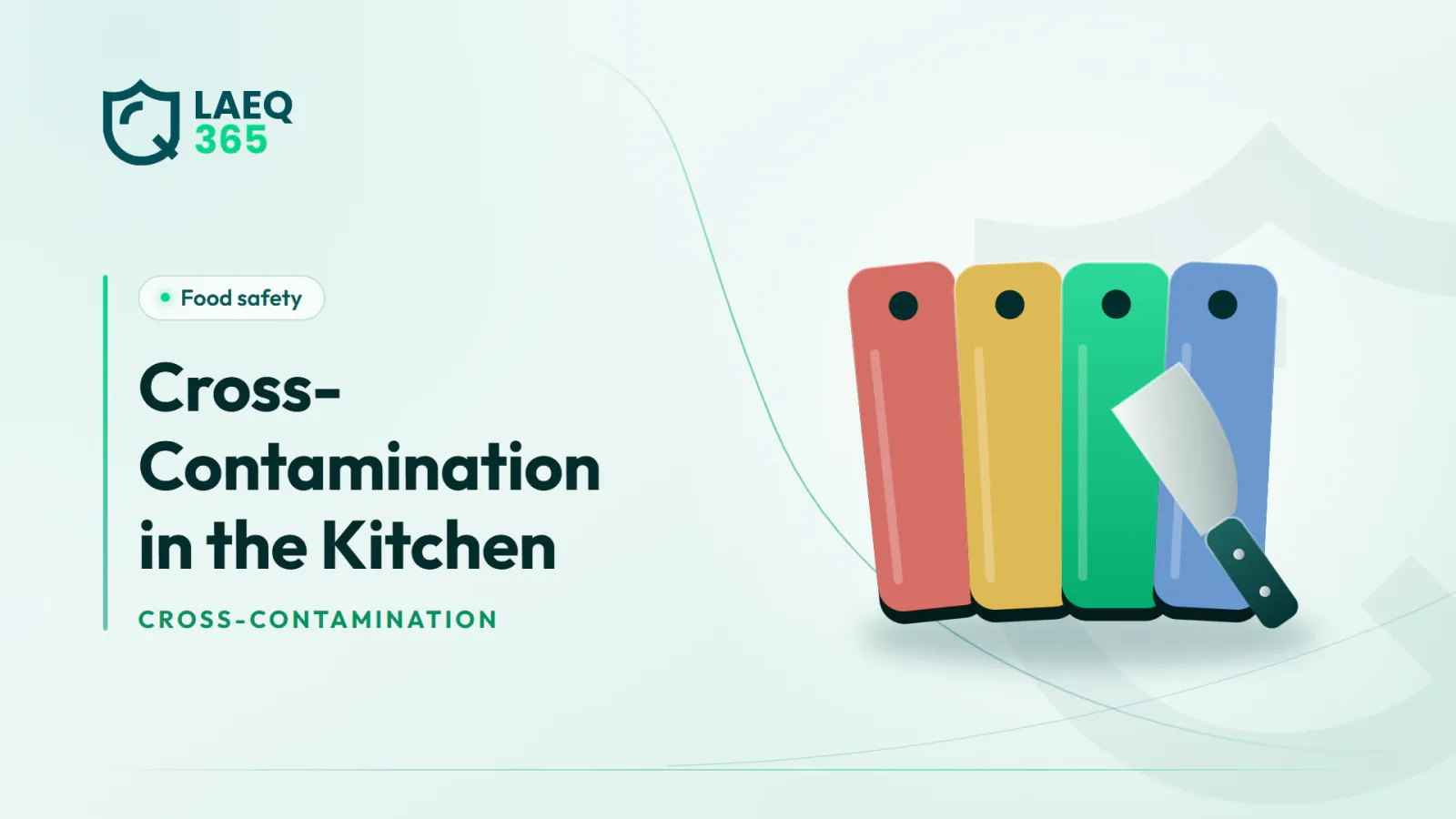
The color system is one of the simplest and most effective tools, because it turns the separation rule into a visual signal that any worker understands, whatever their language. The most widespread system in commercial kitchens is:
- Red: raw red meat.
- Yellow: raw poultry.
- Blue: raw fish and seafood.
- Green: vegetables, fruit and salads.
- Brown: unwashed root vegetables, such as potatoes and carrots.
- White: bakery and dairy products.
Some establishments also use a dedicated color, such as purple, for allergen-free foods. Some colors may differ from one system to another; what matters is that you choose one system, apply it across the whole establishment, and hang an explanatory chart above the prep stations.
For the system to work:
- Use knives with color-coded handles that match the boards.
- Assign a storage spot for each color so the boards are not stacked together.
- Replace deeply scored boards, because cracks trap bacteria and are hard to clean.
- Place a damp cloth or a non-slip mat under the board instead of towels that move between stations.
Remember that colors are an aid, not a substitute for washing and sanitizing after every use.
4. How Should You Organize the Refrigerator to Prevent Cross-Contamination?
The refrigerator is where raw and ready-to-eat foods sit together for long hours, so how it is organized is one of the most important controls against cross-contamination. The basic rule: what needs the least cooking goes at the top, and what needs the highest cooking temperature goes at the bottom, so that juices do not drip onto food that will not be cooked.
The common order from top to bottom:
- Top shelf: ready-to-eat foods, such as cooked dishes, salads, desserts and dairy.
- Then: raw fish and seafood.
- Then: raw whole cuts of meat, such as beef steak and lamb.
- Then: raw ground meat.
- Bottom shelf: raw poultry.
Alongside the order:
- Cover all foods with lids or cling film, and put raw food in deep trays that prevent leaks.
- Do not put food on the floor, even in cold rooms; use shelving raised off the floor.
- Dedicate a separate refrigerator to raw food if space allows; this is the ideal solution.
- Label the shelves with what goes on each, so new workers follow the layout.
- Do not overload the refrigerator, because cold air needs paths to circulate.
On receiving, transfer goods from suppliers' cartons into clean containers before putting them away, because cartons may carry contamination from delivery vehicles and warehouses. For more on organization and dates, see our guide to the FIFO method for food storage.
5. How Do You Separate the Flow of Raw and Ready-to-Eat Food in the Kitchen?
The best way to prevent cross-contamination is for raw food never to meet ready-to-eat food in the first place. This is achieved through separation in space or in time, depending on the size of the kitchen.
Separation in space is the best option:
- A dedicated station for preparing raw meat and poultry, away from the salad and sandwich station.
- A dedicated sink for washing vegetables, separate from the dishwashing sink and the handwashing sink.
- A one-way flow as far as possible: from receiving to storage to raw prep to cooking to service, without cooked food going back to the raw area.
Separation in time is a practical solution for small kitchens, such as café kitchens and food trucks:
- Prepare ready-to-eat foods first, such as salads and cold sauces.
- Then clean and sanitize the surface and tools.
- Then move on to preparing raw meat and poultry.
- Then clean and sanitize again before any other use.
Also watch out for hidden meeting points: transport trays that carry raw chicken to the grill and are then used for the cooked chicken, tongs used for both raw and cooked food on the grill, and marinade that touched raw meat being used as a serving sauce. Assign separate tools to each stage and state this explicitly in the station's procedures.
6. What Role Do Tools, Surfaces and Gloves Play in Cross-Contamination?
Even with good separation, tools, surfaces and hands remain possible carriers of microbes. There is an important difference every staff member must understand between cleaning and sanitizing: cleaning removes visible dirt and grease, while sanitizing reduces microbes to a safe level. Sanitizing does not work well on a surface that is not clean, so cleaning always comes first.
The main risk points in daily practice:
- Multi-use cloth towels: the towel you wipe your hands with, then the surface, then the plates, carries microbes between all of them. Use paper towels or color-coded cloths dedicated to each area.
- The probe thermometer: it goes into raw chicken and then into the finished dish; sanitize it between every measurement.
- Gloves: they are not a magic solution. A glove that touched raw chicken is just as contaminated as a hand and must be changed when moving to ready-to-eat food, with handwashing before putting on a new pair.
- Shared surfaces: scales, refrigerator handles, equipment buttons and order screens.
- Slicers and blenders: they need full disassembly and cleaning between different items.
We have dedicated our hygiene and sanitation section to the details of cleaning and sanitizing programs, sanitizer concentrations and handwashing. What matters here is linking these procedures specifically to the transition points from raw to ready-to-eat food.
7. A Daily Cross-Contamination Prevention Checklist for Restaurants
Turn everything above into a short checklist that the supervisor completes at the start of every shift, and another in the middle of the shift at peak time, when shortcuts multiply. Here is a template you can adapt to your establishment:
- Refrigerators: raw food below ready-to-eat food, all foods covered, and no leaks or juices on the shelves.
- Cutting boards: colors used at their correct stations, and no deeply scored boards.
- Prep stations: no raw food at the salad station, and tools dedicated to each station.
- Sinks: the handwashing sink is accessible, not used for anything else, and stocked with soap and paper towels.
- Gloves: changed when moving between raw and ready-to-eat food, and not a substitute for handwashing.
- Probe thermometer: present with sanitizing wipes at every cooking station.
- Chemicals: stored away from food, with a clear label on every container.
- Allergens: dedicated tools kept separate and known to the staff.
- Trays and tongs: separate tools for raw and cooked food at the grill.
For every non-compliant item, record the observation, the immediate corrective action (such as rearranging the shelf or replacing the board) and the name of the person responsible. Over time, analyzing these observations will show you where the problem keeps recurring: a particular station, a particular shift, or a worker who needs additional coaching.
Conclusion
Preventing cross-contamination rests on one idea: do not let raw food meet ready-to-eat food, either directly or through tools, surfaces and hands. Apply a single color system for cutting boards and knives, organize the refrigerator with raw poultry at the bottom, separate stations in space or time, sanitize the probe and tools at every transition, and do not rely on gloves alone. Then turn all of this into a daily checklist that is carried out and reviewed. With LAEQ365 you can schedule this checklist for every shift, assign corrective actions to their owners, and track them to closure from a single dashboard.
Frequently asked questions
- What is cross-contamination, with a simple example?
Cross-contamination is the transfer of microbes or harmful substances from a food, surface or tool to another food. The best-known example: cutting raw chicken on a board and then cutting salad vegetables on the same board without washing and sanitizing it, so bacteria such as Salmonella transfer to food that will not be cooked and may cause food poisoning in whoever eats it.
- What are the cutting board colors and their uses?
The most widespread system: red for raw red meat, yellow for raw poultry, blue for raw fish, green for vegetables and fruit, brown for unwashed root vegetables, and white for bakery and dairy. Some establishments use purple for allergen-free foods. Colors may differ between systems, so what matters is standardizing one system across the establishment.
- What is the correct order of foods in the refrigerator?
Ready-to-eat foods go on the top shelf, then raw fish, then whole cuts of meat, then ground meat, with raw poultry on the bottom shelf. The rule: whatever needs a higher cooking temperature goes lower down so its juices do not drip onto other food. All foods should be covered and nothing should be placed on the floor.
- Does wearing gloves prevent cross-contamination?
Not on its own. A glove that touched raw chicken is just as contaminated as a hand, and if it is then used to prepare a salad it will transfer bacteria to it. Gloves must be changed when moving from raw to ready-to-eat food, when they tear, and after touching any contaminated surface, with handwashing before putting on a new pair.
- Should raw chicken be washed before cooking?
No, it is not recommended. Washing raw chicken under water does not remove bacteria effectively; instead it spreads them through splashes to the sink, surfaces and nearby foods, increasing the risk of cross-contamination. The safe method is to cook the chicken until its core temperature reaches about 74°C, which is enough to kill the bacteria.