How to succeed at restaurant digital transformation: move from paper checklists to AI-powered digital inspection reports, with real steps and challenges.
1. What Is Restaurant Digital Transformation and Why Is It Now Essential?
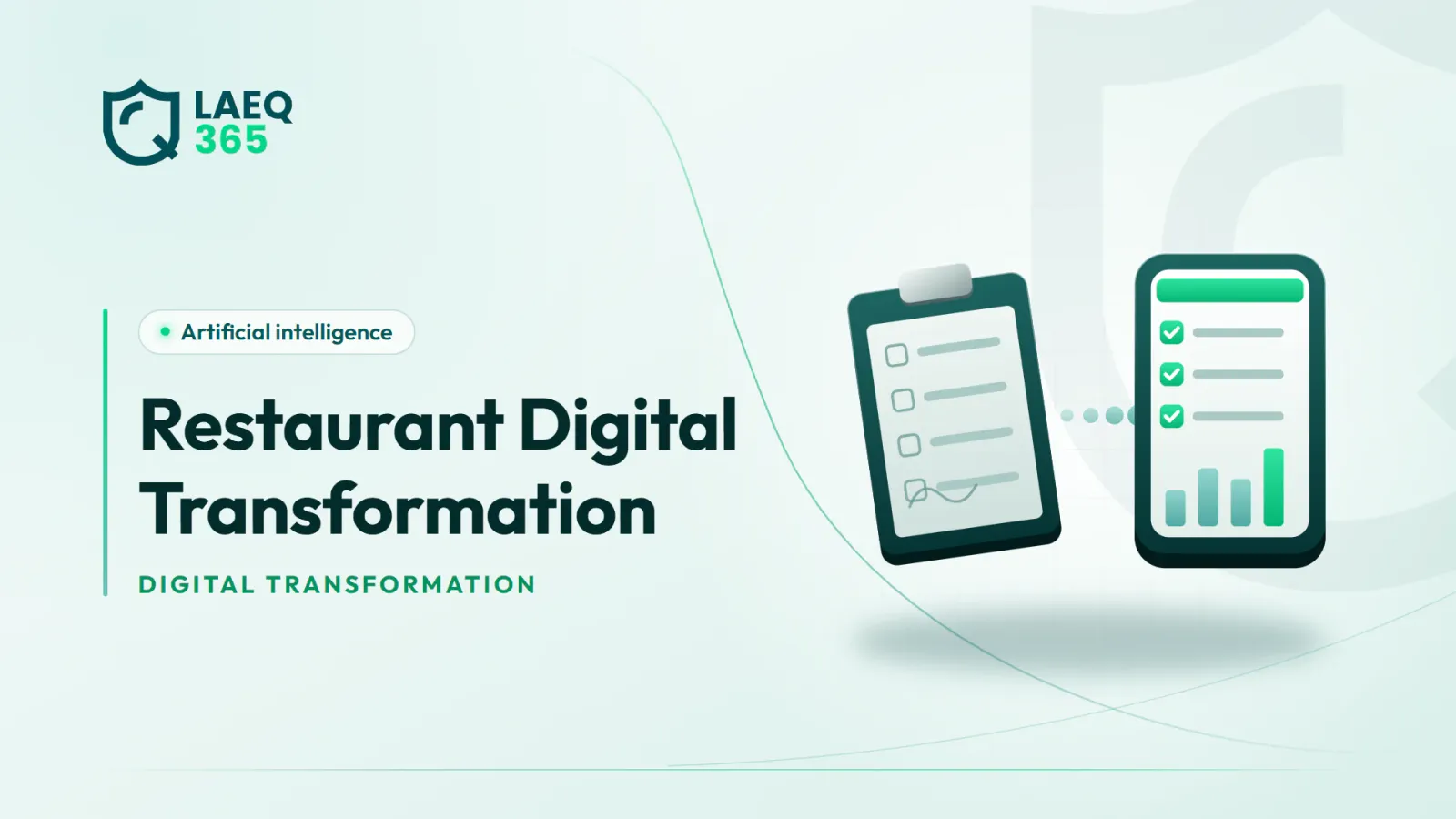
Restaurant digital transformation means moving daily operations, from checklists and internal inspections to task assignment and corrective action follow-up, away from paper, phone calls and chat groups and into a unified digital system that stores and organizes data and makes it ready for analysis. In food safety specifically, it means every check, every observation and every repair is documented with a date, an owner and evidence.
Why has this become a necessity rather than a luxury? Because restaurants today operate in an environment that demands more speed and transparency:
- Group expansion: many Saudi brands run branches in several cities, which cannot be monitored on paper.
- Regulatory expectations: regulators and consumers expect a consistent standard of hygiene and safety in every branch.
- Staff turnover: procedures written into a system are not lost when an employee who kept them in their head leaves.
- Data-driven decisions: management needs real numbers, not impressions, when evaluating branches.
This direction is also in line with the Kingdom's wider digital transformation under Vision 2030, which we cover in our article on Vision 2030 and AI in the food sector. Most importantly, digitization is the foundation on which any later use of AI is built.
2. What Are the Problems with Paper Checklists in Kitchens?
Paper checklists have served restaurants for many years, but they have flaws that become obvious as a business grows:
- Box-ticking: it is common for the temperature log to be filled in all at once at the end of the shift with similar numbers, without the checks actually having been done on time.
- Hard to verify: there is nothing to prove when the form was filled in or who actually did it, and no photo to support the observation.
- Loss and damage: papers get wet in the kitchen and lost in drawers, and are hard to retrieve when needed.
- No full picture: the regional manager only sees what happens in branches when visiting them or when a late, compiled file arrives.
- A broken loop: the observation is written down, but nothing links it to a corrective action or later follow-up.
- Analysis is impossible: no person or system can uncover patterns in stacks of paper without re-entering all of it.
Some restaurants have moved to a halfway solution: photographing paper checklists and sending them to a chat group. This partly solves the loss problem, but it creates an archive of images that cannot be searched or analyzed, and it buries managers in messages that are hard to keep up with. Real digital transformation means structured data, not photos of paper.
3. What Are the Steps to Move from Paper to a Digital Inspection System?
A successful transition does not happen through a management decision in a single day, but through deliberate steps that reduce resistance and keep operations running:
- Inventory your current checklists: gather every paper form used across branches, and you will often discover several versions of the same form.
- Standardize and clean up items: remove duplicates, unify the wording, group items into clear areas and identify the critical ones.
- Choose the system: ideally one that works on mobile, supports photos and notes, and links each observation to a corrective action and an assigned task.
- A pilot branch: start with one branch whose manager is enthusiastic about change, and collect the team's feedback.
- A short parallel run: in some cases it helps to keep paper temporarily for a very short period until the team trusts the system, then stop it for good.
- Roll out and train: move the remaining branches in batches, with short, hands-on training for each team.
- Officially retire paper: set a clear date for stopping paper forms and announce it to all branches in advance; otherwise the duplication will go on indefinitely.
To go deeper into designing the checklists themselves and running internal inspections, see the articles in the Inspection section of our blog.
4. How Do You Move from Digital Reports to AI-Powered Reports?
Once digitization has settled and data has built up, the most valuable stage begins: turning reports from records into insights. This is where AI comes in.
A regular digital report tells you what happened: the branch received a certain score and failed specific items. An AI-powered report adds further layers:
- A written summary: a short paragraph explaining the main weaknesses and strengths in plain language.
- Comparison with the past: are these observations new, or have they been recurring since previous visits?
- Links across branches: is the same problem showing up in other branches, suggesting a central cause?
- Suggested actions: an initial draft of corrective actions for the responsible person to review.
- Answers to questions: the ability to ask the system about any detail in the reports in natural language.
The move usually does not require changing systems if the digital system you chose has built-in smart analysis capabilities. This is one reason it matters to choose an integrated platform from the start, rather than a standalone inspection system whose data has to be exported manually into another analysis tool.
For details on this stage, read our guide to AI inspection report analysis.
5. What Are the Common Challenges in Digitizing Restaurant Operations, and How Do You Overcome Them?
Every digital transformation project runs into obstacles, and knowing them in advance makes them easier to handle:
- Resistance from long-serving staff: some have used paper for years. Solution: involve them early, choose a very simple interface and show them how it saves them work.
- Multiple languages: kitchen teams in the Kingdom are often multinational. Solution: a system that supports more than one language, with clearly written items and illustrative photos where needed.
- Poor connectivity in some locations: such as warehouses or cold rooms. Solution: check how the system behaves on a weak network before relying on it.
- Low-quality data entry: rushed form-filling with no notes. Solution: make a note mandatory on every failure and periodically review a sample of reports.
- No internal owner: the system is bought and then abandoned. Solution: appoint a clear project owner with real authority.
- Trying to digitize everything at once: Solution: start with internal inspections and corrective actions, then add tasks, assets and training later.
Notice that most of these challenges are organizational rather than technical: the success of digital transformation depends on leadership and follow-up as much as on the quality of the software itself.
6. What Return Can You Expect from Digital Transformation in Food Safety?
The return varies from one business to another depending on the starting point and how seriously the change is implemented, so we avoid promising specific numbers. But there are qualitative benefits that recur in successful experiences:
- Instant visibility: management sees inspection results the moment the report is closed, not days later.
- Clear accountability: every observation has an owner and a deadline, and every corrective action has a trackable status.
- Greater readiness for official inspections: records are organized and can be retrieved quickly.
- Saved management time: less time wasted collecting, transporting and retyping paperwork.
- A foundation for smart analysis: structured data opens the door to automatically detecting recurring problems and setting priorities.
- Protected know-how: procedures and operating history stay with the business even as staff change.
To estimate the return in your business, record a few simple indicators before you start: the time it takes to prepare the weekly report, the average time to close corrective actions and the number of recurring observations in internal inspections. Then compare them after a few months of regular operation. This realistic comparison is more honest than any generic figure quoted in sales presentations, and it helps you convince senior management to continue and expand the project.
Conclusion
Restaurant digital transformation is the step that comes before any serious use of AI: standardize your checklists, move them to a mobile system, link every observation to a corrective action and an owner, then officially retire paper. After that, your reports become ready for smart analysis, and you move from recording what happened to understanding why it keeps happening. LAEQ365 brings these stages together in one platform, from digital inspection checklists, tasks and corrective actions to the smart assistant “Q” that analyzes your reports. Explore the LAEQ365 plans and start with a pilot branch.
Frequently asked questions
- What is the difference between digital transformation and automation in restaurants?
Digital transformation is a broader concept that means reorganizing how work is done around data and digital systems, while automation means carrying out a specific task automatically without human intervention, such as sending an alert when a temperature limit is exceeded. Automation is part of digital transformation, but transformation also includes changing procedures, roles and the culture of data-driven decision-making.
- Can a small restaurant start digital transformation?
Yes, and it may even be easier, because there are fewer staff and forms. A small restaurant can start by digitizing its daily inspection checklist and corrective action log on mobile, then add task assignment and asset tracking later. The key is choosing a simple system that fits the size of the business and can scale as it grows.
- Should paper checklists be stopped immediately when the digital system starts?
Stopping immediately in all branches at once is not recommended. It is better to trial the system in one branch, possibly with a short parallel run until the team trusts it, and then set a clear official date for retiring paper. Keeping paper with no end date creates exhausting duplication and weakens commitment to the digital system.
- Is digital transformation a prerequisite for using AI in restaurants?
In practice, yes. AI needs structured data to analyze, and paper reports or photos scattered across chat groups are unsuitable for this, however advanced the tool. That is why digitization comes first, with smart analysis following once enough data has built up in a consistent format. Integrated systems combine both stages in a single platform.
- How long does digital transformation of inspection operations take in a restaurant group?
It depends on the number of branches, the team's readiness and how standardized the current forms are. A group with unified checklists and a cooperative team moves much faster than one where every branch has its own forms. More important than speed is moving in batches, with hands-on training and an internal owner who monitors adoption.